In this story
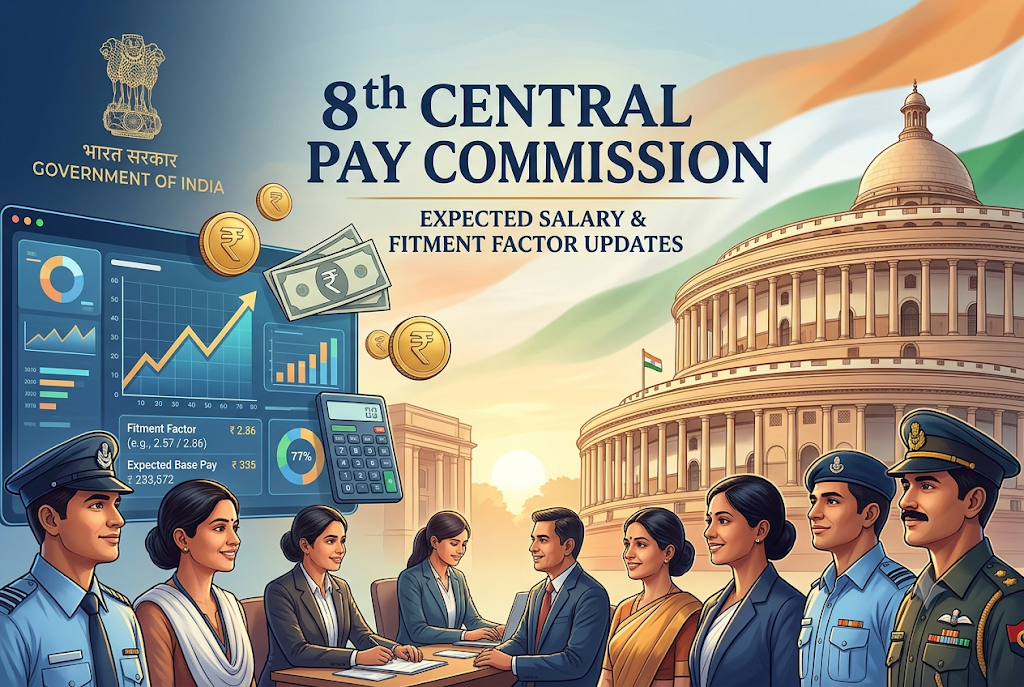
Central Pay Commissions (CPCs) are among the most significant economic events for India’s public sector. Constituted approximately once every decade, these bodies recalibrate the salaries, pensions, and allowances of more than 48 lakh central government employees and nearly 68 lakh pensioners.
As discussions around the 8th Central Pay Commission gain momentum, questions dominate every staff lounge and finance desk: What will the fitment factor be? How high will the entry-level minimum wage go? What will the actual in-hand salary look like once Dearness Allowance (DA) resets to zero?
This comprehensive guide unpacks the history of pay commissions, breaks down the mathematical mechanics behind pay revisions, evaluates realistic fitment factor scenarios, and illustrates what your monthly payslip could look like under the 8th CPC.
1. Evolution of Pay Commissions in India: A Historical Snapshot
To understand what to expect from the 8th CPC, we must look at how previous commissions reshaped compensation structures across the decades:
[1st–3rd CPC: 1946–1973] ➔ Standardised colonial-era fragmented scales
[4th CPC: 1986]          ➔ Minimum wage based on subsistence food basket metrics
[5th CPC: 1997]          ➔ Sharp pay hike; compressed dozens of grades into unified scales
[6th CPC: 2006]          ➔ Introduced Pay Bands, Grade Pay (GP), & Fitment Factor (1.86)
[7th CPC: 2016]          ➔ Scrapped Grade Pay; introduced Pay Matrix & 2.57 Fitment Factor
[8th CPC: Underway]      ➔ Expected revision of Pay Matrix, DA absorption, & pension parity
- 5th Pay Commission (1997): Implemented substantial raises to insulate employees against high inflation in the 1990s and reduced the proliferation of hundreds of arbitrary grades.
- 6th Pay Commission (2006): Overhauled basic scales by introducing Pay Bands and Grade Pay (GP). It also popularized the Fitment Factor concept (set at 1.86), allowing a direct multiplier to compute revised base pay.
- 7th Pay Commission (2016): Replaced the contentious Grade Pay system with a clear Pay Matrix (Levels 1 to 18). It applied a uniform fitment factor of 2.57, raising the baseline minimum wage from ₹7,000 to ₹18,000 per month, while setting the top apex salary (Cabinet Secretary) at ₹2,50,000.
2. Core Mechanics: How Does a Pay Revision Actually Work?
A common misconception among employees is that a 2.5× fitment factor means taking home two-and-a-half times more in cash every month. In reality, Pay Commission revisions involve a structural re-absorption and reset of allowances.
The Fitment Factor Equation
The basic pay under any new pay commission is calculated as:$$\text{Revised Basic Pay} = \text{Pre-Revision Basic Pay} \times \text{Fitment Factor}$$
The fitment factor consists of two key components:
- Absorption of Merged Dearness Allowance (DA): By the time a pay commission cycle ends, DA (which hedges against consumer price inflation) has accumulated to substantial levels (often 50%–60%+). The new pay commission folds this accumulated DA into the new base pay.
- The Real Wage Hike: The net real raise in purchasing power given over and above the merged inflation index.
The DA “Reset to Zero” Phenomenon
When the new pay structure becomes operational:
- The accrued DA drops back to 0%.
- Over subsequent quarters, DA begins climbing again based on the All India Consumer Price Index for Industrial Workers ($AICPI-IW$).
- Because the base pay is now much higher, each subsequent $1\%$ increase in DA yields a significantly larger rupee amount.
3. Projected Fitment Factors & Minimum Wage Scenarios
Employee federations and staff associations—such as the National Council (Staff Side) Joint Consultative Machinery (NC-JCM) and Indian Railways Technical Supervisors Association (IRTSA)—have historically lobbied for multipliers between 2.86 and 3.68, aiming for a minimum entry-level wage between ₹51,000 and ₹65,000+.
However, balancing employee purchasing power against fiscal deficit targets typically results in a negotiated outcome. Here is how key scenarios compare:
| Scenario | Fitment Factor | Level 1 Minimum Basic (Current: ₹18,000) | Level 6 Entry Basic (Current: ₹35,400) | Level 10 Entry Basic (Current: ₹56,100) |
|---|---|---|---|---|
| Conservative (DA Merge + ~15% Hike) | 1.92 | ₹34,600 | ₹68,000 | ₹1,07,700 |
| Median Expected (Balanced Model) | 2.28 | ₹41,000 | ₹80,700 | ₹1,27,900 |
| Optimistic (Matching 7th CPC Multiplier) | 2.57 | ₹46,300 | ₹91,000 | ₹1,44,200 |
| Upper Federation Ask | 2.86 | ₹51,500 | ₹1,01,200 | ₹1,60,400 |
(Note: Calculated basic values are rounded up to the nearest ₹100 in accordance with standard Pay Commission convention).
4. Indicative 8th CPC Pay Matrix Across Key Ranks (At 2.28 Fitment Factor)
Assuming the widely projected 2.28 median fitment factor, here is how entry-level basic pay would look across standard pay matrix tiers:
| Pay Level | Illustrative Roles & Posts | 7th CPC Entry Basic | Projected 8th CPC Entry Basic (FF: 2.28) |
|---|---|---|---|
| Level 1 | Multi-Tasking Staff (MTS), Office Attendants, Track Maintainers | ₹18,000 | ₹41,000 |
| Level 2 | Lower Division Clerks (LDC), Junior Constables | ₹19,900 | ₹45,400 |
| Level 4 | Upper Division Clerks (UDC), Tax Assistants | ₹25,500 | ₹58,100 |
| Level 6 | Sub-Inspectors, Junior Engineers (JE), Primary Headmasters | ₹35,400 | ₹80,700 |
| Level 7 | Section Officers, Inspectors (GST/IT/Customs), ASOs | ₹44,900 | ₹1,02,400 |
| Level 8 | Assistant Accounts Officers (AAO), Senior Section Officers | ₹47,600 | ₹1,08,500 |
| Level 10 | Group ‘A’ Entry (UPSC CSE / IFoS / IES / DANIPS) | ₹56,100 | ₹1,27,900 |
| Level 12 | Executive Engineers, Deputy Secretaries | ₹78,800 | ₹1,79,700 |
| Level 14 | Joint Secretaries to GoI, Chief Engineers | ₹1,44,200 | ₹3,28,800 |
| Level 17 | Secretary to GoI, Directors General | ₹2,25,000 | ₹5,13,000 |
| Level 18 | Cabinet Secretary of India | ₹2,50,000 | ₹5,70,000 |
5. Anatomy of the Pay Slip: Allowances & In-Hand Salary Calculation
A shift in basic pay affects every line item on an employee’s monthly payslip.
1. House Rent Allowance (HRA)
HRA is categorized by city classification:
- Class X (Tier 1 Metros): 30% of Basic Pay
- Class Y (Tier 2 Cities): 20% of Basic Pay
- Class Z (Rural / Small Towns): 10% of Basic Pay
(Note: Rates reflect standard adjustments triggered when DA crossed past 50%).
2. Transport Allowance (TA)
Transport allowance is paid at fixed rates depending on pay level and posting location (Higher Transport Allowance Cities vs. Other Cities), indexed to inflation.
3. Statutory Deductions
- Pension Tier-1 (NPS / UPS): Deducted at $10\%$ of $(\text{Basic Pay} + \text{DA})$.
- CGHS (Central Government Health Scheme): Fixed monthly deduction based on pay grade.
- CGEGIS (Central Government Employees Group Insurance Scheme): Nominal fixed deduction.
In-Hand Salary Case Study: Level 7 Officer (Metro City)
Let us compare the monthly pay of an Inspector / Assistant Section Officer (Level 7, Index 1) posted in an ‘X’ Category Metro (e.g., Delhi, Mumbai, Bengaluru):
Gross Pay = Basic Pay + DA + HRA + TA
Net Pay   = Gross Pay - (NPS/UPS Contribution + CGHS + CGEGIS + Income Tax)
| Pay Component | Pre-Revision (7th CPC at 53% DA) | Projected 8th CPC (FF: 2.28, DA: 0%) |
|---|---|---|
| Basic Pay | ₹44,900 | ₹1,02,400 |
| Dearness Allowance (DA) | ₹23,797 (53%) | ₹0 (Reset) |
| House Rent Allowance (HRA – 30%) | ₹13,470 | ₹30,720 |
| Transport Allowance (TA + DA index) | ₹5,508 | ~₹7,200 |
| Total Gross Salary | ₹87,675 | ₹1,40,320 |
| Less: NPS / UPS Contribution (10%) | ₹6,870 | ₹10,240 |
| Less: CGHS & Insurance Deductions | ~₹700 | ~₹1,200 |
| Estimated Net Monthly Take-Home (Pre-Tax) | ₹80,105 | ₹1,28,880 |
Result: While the basic pay more than doubles on paper, the effective net monthly take-home increases by approximately 30%–35% initially, due to the resetting of the 53%+ DA to zero and higher percentage-linked deductions.
6. Impact on Pensioners: Unified Pension Scheme (UPS) and Dearness Relief
For India’s 68+ lakh pensioners, the 8th Pay Commission brings two major structural benefits:
- Revision of Minimum Pension: Under the 7th CPC, the minimum pension was set at ₹9,000 per month (50% of the Level 1 minimum pay of ₹18,000). Under a 2.28 fitment factor, the minimum pension is expected to jump to ₹20,500 per month.
- Unified Pension Scheme (UPS) Integration: With the introduction of the UPS—which guarantees an assured pension of 50% of the average basic pay drawn in the last 12 months prior to retirement (for qualifying service of 25+ years)—the revised pay scales will directly lift the baseline calculation for both upcoming retirees and existing beneficiaries.
- Dearness Relief (DR): Similar to DA for active personnel, Dearness Relief for pensioners will reset to 0% and begin compounding anew over the higher base pension.
7. Implementation Timeline, Report Submission, and Arrears
Understanding the timeline helps set clear expectations:
[Cabinet Approval / Terms of Reference]
              ▼
[Commission Consultations & Memorandums]  (12 to 18 Months)
              ▼
[Final Report Submission to Finance Ministry]
              ▼
[Cabinet Evaluation & Empowered Committee Review]
              ▼
[Gazette Notification & Implementation]
              ▼
[Disbursement of Retrospective Arrears]
- The Effective Date: Traditionally, Pay Commissions take effect on the first day following the end of the previous 10-year term (i.e., 1 January 2026).
- The Notification Date: Deliberations, public hearings, fiscal balancing, and departmental approvals mean the final Gazette notification often arrives months later.
- Arrears: When implementation is notified retroactively, the central government disburses the accumulated difference (Revised Basic + Allowances minus Paid Basic + Allowances) as a lump-sum arrears payout, typically distributed across one or more fiscal quarters.
8. Frequently Asked Questions (FAQs)
What is the expected minimum salary under the 8th Pay Commission?
Based on projected fitment factors ranging between 2.28 and 2.57, the minimum basic salary for Level 1 employees is expected to rise from the current ₹18,000 to between ₹41,000 and ₹46,300 per month.
Will the Pay Matrix system continue under the 8th CPC?
Yes. The Pay Matrix structure introduced in the 7th CPC has simplified career progression, annual 3% increments, and promotional pay tracking. The 8th Pay Commission is expected to retain the matrix framework while revising the baseline indices and multipliers.
Does a higher fitment factor guarantee double take-home salary?
No. Because accumulated Dearness Allowance (DA) is merged into the new basic pay and then reset to 0%, a significant portion of the fitment multiplier accounts for inflation compensation already being received. The net real boost in take-home pay typically ranges between 20% and 35%.
Will state government employees also benefit from the 8th CPC?
State governments are not directly governed by Central Pay Commission notifications. However, historically, almost all Indian states adopt the Central Pay Commission’s structural matrix and fitment recommendations within 6 to 18 months of central notification, subject to their state-level fiscal health.
Conclusion
The 8th Pay Commission represents a major recalibration of real wages against long-term inflation for India’s public sector workforce. While union proposals advocate for fitment factors above 3.0, fiscal realities and historical precedents suggest a balanced multiplier near 2.28 to 2.57.
As formal reports are finalized and reviewed by the Union Cabinet, central employees and pensioners can look forward to a structured boost in basic compensation, enhanced social security benefits, and an upgraded baseline across the entire Pay Matrix.