In this story
An everyday guide to building a financial safety net in India—even when you cannot save much.
It is the 22nd of the month. Your rent is paid, groceries are stocked, and you have just enough money to get through until payday.
Then your scooter breaks down.
The repair will cost ₹6,000. You need the scooter to get to work. Waiting until next month is not really an option.
You open your banking app, do the maths twice and begin considering whom to call.
Now imagine the same situation with ₹20,000 set aside for unexpected expenses. The repair is still frustrating. You would still rather spend that money elsewhere. But you can make the payment without immediately borrowing or asking someone for help.
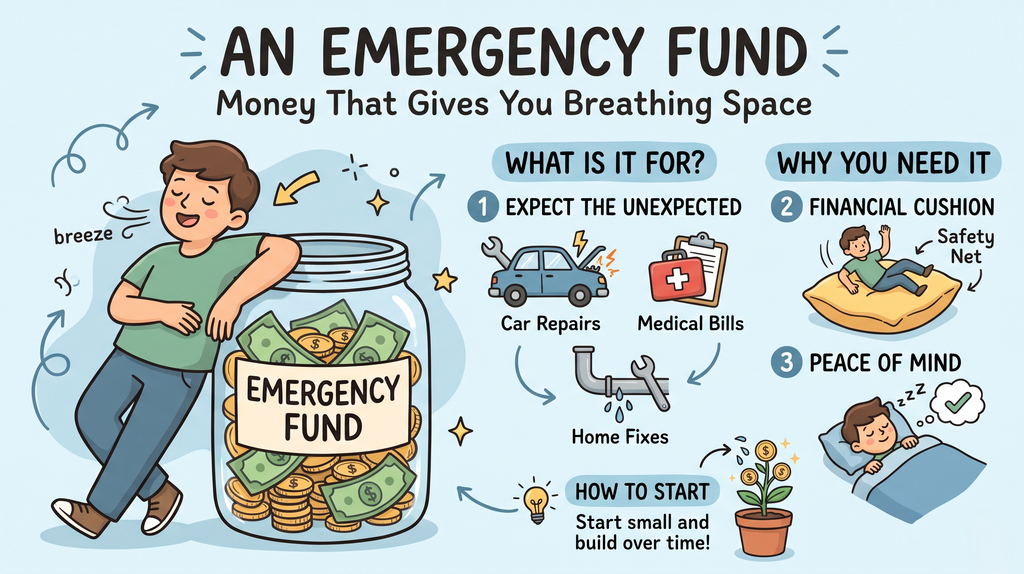
That is what an emergency fund offers: money you can access when an unexpected event disrupts your finances. Its purpose is to help you meet urgent expenses or keep the household running when income stops.
It will not prevent life from going wrong. It can give you more room to respond when it does.
1. What Exactly Is an Emergency Fund?
An emergency fund is a reserve kept specifically for unexpected, necessary expenses or a temporary loss of income.
The National Institute of Securities Markets, or NISM, describes financial emergencies as situations requiring urgent money for unplanned events, including illness, disability, job loss or business closure. The difficulty is straightforward: income may stop, but household expenses do not—and sometimes they increase.
Your emergency fund has a different job from your other savings:
| Type of money | Its main purpose |
|---|---|
| Monthly spending money | Paying routine bills and living expenses |
| Planned-expense savings | Preparing for known costs, such as school fees or travel |
| Emergency fund | Handling unexpected financial disruptions |
| Long-term investments | Working towards future goals |
Keeping these purposes distinct helps you see what your savings can actually cover.
For example, if you have ₹50,000 in the bank but ₹40,000 is already committed to an upcoming fee payment, the full ₹50,000 is not freely available for emergencies.
2. What Counts as an Emergency?
Not every unplanned purchase deserves emergency money.
A helpful personal test is to ask:
- Is the expense necessary?
- Does it need attention soon?
- Would delaying it put health, safety, essential income or basic living needs at risk?
This is a decision-making framework, not a strict financial rule. Your circumstances matter.
Situations that may justify using the fund
- Covering essential household expenses after losing a job.
- Paying for urgent medical needs.
- Repairing a vehicle necessary for earning an income.
- Making necessary travel arrangements during a family crisis.
- Meeting essential expenses while self-employment income is interrupted.
These examples follow the central purpose of emergency savings: providing accessible money during unexpected financial hardship.nism.ac+1
Expenses to plan for separately
A festival celebration, annual insurance premium, school admission payment or planned trip home may place pressure on your budget. But if you know the expense is coming, try to give it a separate savings allocation.
For instance, an expected ₹12,000 annual expense can be planned for by setting aside ₹1,000 a month.
There will be grey areas. An essential appliance failing unexpectedly may be an emergency; replacing a working one during a sale probably is not.
The aim is not to police yourself harshly. It is to protect money that you may need for something more serious.
3. How Much Should You Save?
A commonly suggested starting range is three to six months of household expenses. NISM notes that some advisers suggest six to twelve months where a larger cushion is appropriate. These are planning ranges, not a compulsory amount for every household.
The important detail is that the calculation is based on expenses—not automatically on your salary.
Work out your essential monthly expenses
Imagine a fictional household in New Delhi with the following monthly commitments:
| Essential expense | Monthly amount |
|---|---|
| Rent | ₹9,000 |
| Groceries and basic household supplies | ₹6,000 |
| Electricity, cooking gas, phone and internet | ₹2,500 |
| Necessary transport | ₹2,000 |
| Regular medicines | ₹1,500 |
| Essential family support | ₹3,000 |
| Existing loan repayment | ₹3,000 |
| Total | ₹27,000 |
For this household:
| Reserve period | Illustrative target |
|---|---|
| One month | ₹27,000 |
| Three months | ₹81,000 |
| Six months | ₹1,62,000 |
These figures are examples, not a recommended budget.
Include commitments you would still have to meet during a difficult period. Account for unavoidable non-monthly payments too, without counting money twice if you already maintain a separate reserve for them.
Choose a target that reflects your circumstances
When deciding where to sit within—or beyond—the suggested range, consider:
- How predictable your income is.
- How long replacing that income might take.
- Whether other household members earn.
- How many people depend on you.
- Your unavoidable repayments.
- Your health-related commitments.
- Whether dependable financial support is genuinely available.
These questions help personalise the expense-based framework. NISM specifically identifies both employment loss and interrupted business income as reasons for maintaining a reserve.
Two people earning the same salary can reasonably need different emergency funds.
4. Start Small If the Full Target Feels Impossible
A six-month target can feel discouraging when saving ₹1,000 is already difficult.
You do not have to build the whole fund at once.
Try setting milestones:
- First milestone: ₹5,000.
- Second milestone: ₹10,000.
- Third milestone: one month of essential expenses.
- Later milestones: work towards your chosen household target.
These are suggested stepping stones, not official thresholds.
If you set aside ₹1,500 each month, you would contribute ₹18,000 over a year, before considering interest or withdrawals. That may not cover a long income interruption, but it is a meaningful reserve compared with having nothing available.
A small beginning does not make the goal less worthwhile.
The useful question is not, “Why haven’t I saved six months already?”
It is, “What can I put aside without making this month’s essential bills unmanageable?”
5. Where Should You Keep Your Emergency Fund?
The priorities are safety and liquidity. Liquidity means how readily you can access the money when you need it.
NISM emphasises that earning high returns is not the objective of an emergency fund. Its job is to provide accessible money during a difficult situation.
For a beginner, simplicity matters. You should understand where the money is, how to withdraw it and what restrictions apply.
A separate savings account: a straightforward starting point
NISM identifies bank-held money as one of the appropriate ways to maintain emergency savings.
A separate account can also make the boundary clearer: this balance is not available for everyday shopping.
When choosing an account, check:
- Minimum-balance requirements.
- Account charges.
- Withdrawal and transfer limits.
- The access methods available to you.
- Whether account details and contact information are up to date.
Do not assume an account is convenient simply because opening it was easy.
A deposit arrangement: understand access before using it
If you consider keeping part of the reserve in a bank deposit or a sweep arrangement, read the bank’s actual terms first.
Ask whether you can withdraw early, whether partial withdrawals are possible, what penalties apply and how quickly the money becomes available. Product features differ, so avoid locking away money you may need immediately.
The principle remains the same: a higher quoted return is not useful if you cannot access the money when required.
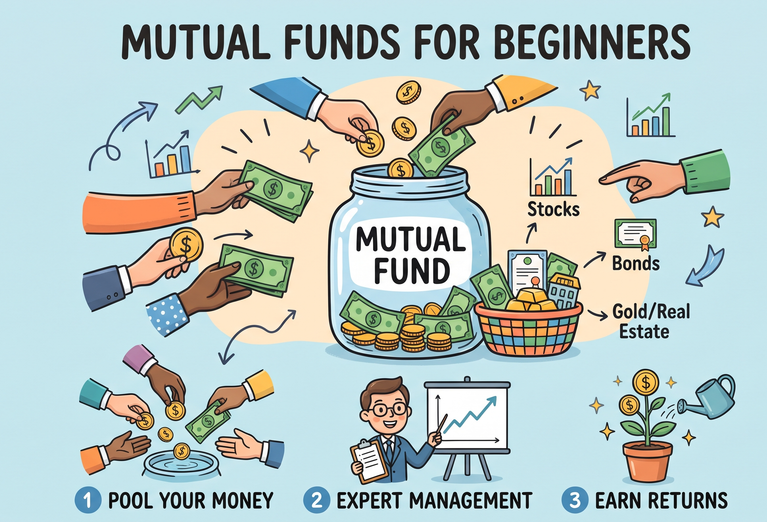
Liquid mutual funds: an option to understand, not a requirement
NISM mentions liquid mutual funds as another possible emergency-fund vehicle. However, mutual funds are not covered by DICGC bank-deposit insurance.nism.ac+1
Before considering one, understand its risks, expenses, redemption arrangements and when money will actually reach your bank account. Do not treat the word “liquid” as a guarantee of instant access.
You do not need a mutual fund to begin building an emergency reserve. An arrangement you understand and can access reliably is more useful than a complicated one you selected mainly for returns.
6. How to Build the Fund Without Making Life Miserable
A savings plan should fit your actual income, responsibilities and limitations.
NISM recommends beginning with a budget, identifying necessary commitments and reviewing discretionary expenses to create room for emergency saving.
Here is a practical way to apply that guidance.
Step 1: Choose a manageable contribution
Decide what you can set aside after allowing for essential bills and unavoidable commitments.
That might be ₹500, ₹2,000 or more. Do not choose an impressive-looking amount that forces you to borrow for groceries later.
Step 2: Make the contribution deliberate
If you receive a regular salary, consider scheduling the transfer near payday.
If your income varies, you could choose a small baseline contribution and add more during stronger months. Treat this as a flexible personal system rather than a rule you must follow regardless of circumstances.
Step 3: Review expenses without blaming yourself
Look for spending you would genuinely prefer to redirect: an unused subscription, repeated convenience purchases or a service you no longer value.
But be realistic. Some budgets are already stretched. If rent, food, care responsibilities and repayments consume most of your income, the problem may not be a lack of discipline.
NISM’s budgeting guidance distinguishes between mandatory expenses and discretionary spending—the latter generally offers more room for adjustment.
Step 4: Decide how to use occasional extra money
When a bonus, gift or additional payment arrives, decide whether part of it can strengthen the reserve.
You can create your own split between immediate needs, enjoyment and saving. There is no universal percentage that fits every household.
Step 5: Track progress in months of coverage
Instead of only recording the rupee balance, calculate:
Months of coverage=Essential monthly expensesEmergency fund balance
For example, ₹40,000 against essential expenses of ₹20,000 provides two months of coverage, assuming those expenses remain unchanged.
This connects the balance to its purpose: how long it could help support you.
7. A Credit Limit Is Not the Same as a Reserve
For planning purposes, do not count an unused borrowing limit as money you have saved.
Borrowed money creates a repayment obligation. Your emergency fund is meant to give you access to your own resources during a disruption.
This matters especially when the emergency involves reduced income: paying an urgent bill is one problem, and funding the later repayments is another.
NISM’s rationale for an emergency reserve is precisely that household expenses continue even when income stops.
Credit may be part of someone’s response to an immediate crisis, but it should not be mistaken for a completed savings goal.
8. Should You Use the Fund When Something Goes Wrong?
Yes—when the situation fits the purpose you set for it.
Imagine you have saved ₹30,000 and need ₹8,000 for a genuine emergency. Afterwards, the balance is ₹22,000.
That does not mean the plan failed. The reserve did what it was meant to do.
A simple use-and-rebuild process is:
- Confirm that the expense is necessary and urgent.
- Work out the amount actually required.
- Use the fund without treating the withdrawal as a personal failure.
- Review your remaining coverage.
- Restart contributions when your finances allow.
The goal is not to preserve a perfect balance at all costs. It is to make the money available when financial hardship occurs.
9. Review the Target When Your Life Changes
Your first target should not become a permanent number you never revisit.
Recalculate when you move, take on a major repayment, become responsible for another person or experience a substantial income change.
An expense-based target needs updating when the expenses or the household circumstances change. That follows directly from NISM’s guidance to size the reserve around household spending.
A once-a-year review is a useful personal routine. A major life event is another good reason to check sooner.
Ask:
- What are our essential monthly expenses now?
- How many months would the current balance cover?
- Is the money still easy to access?
- Have we spent any of it without rebuilding?
- Are known upcoming bills already provided for?
This is maintenance, not a fresh financial overhaul.
10. A Simple First-Month Action Plan
You can begin without choosing an investment product or waiting for a salary increase.
| When | Action |
|---|---|
| This week | List essential expenses and unavoidable commitments |
| Next | Choose an initial milestone and a longer-term target |
| After that | Decide where the money will be held and check access conditions |
| On the next income date | Make a contribution you can reasonably afford |
| At month-end | Review the balance and adjust the plan if needed |
This turns the basic guidance—budget, save and prioritise access—into a manageable routine.nism.ac+1
Do not worry if the first month is modest. A workable system is more valuable than an ambitious promise you cannot sustain.
The Bottom Line: Give Yourself More Than One Way Through a Difficult Month
An emergency fund is not the most exciting part of personal finance.
It does not come with a new phone, a holiday photograph or the thrill of a rising investment account.
Its value is quieter: money available when an income interruption or urgent expense would otherwise leave you scrambling. That is why its priorities are access and safety, not maximum returns.
Start with a figure that feels possible. Build towards a target that reflects your household. Keep the money somewhere you understand, and use it when a genuine emergency arrives.
You are not trying to predict every problem.
You are giving yourself breathing space when one turns up.
This article is for general financial education, not personalised financial advice. All household scenarios, budgets and savings milestones are illustrative. Choose arrangements suited to your circumstances and read the relevant account or product terms carefully.